Tuesday, 14 March 2017


Friday, 3 March 2017
Monitoring the Bull Market in Indian Stocks: Update as of February 2017
Indian Stock Market Watch
On a month-end basis, market capitalisation of stocks on BSE reached an all-time high of Rs 117,593 bill. As a percentage of GNP, however, the estimated ratio is well below the the 85.2% mark reached in February 2015 and 100.7% mark reached in September 2010.


Please see my blog of July 9, 2014 for the original note on using TMV/GNP ratio to gauge whether the market is cheap or expensive.
On a month-end basis, market capitalisation of stocks on BSE reached an all-time high of Rs 117,593 bill. As a percentage of GNP, however, the estimated ratio is well below the the 85.2% mark reached in February 2015 and 100.7% mark reached in September 2010.


Please see my blog of July 9, 2014 for the original note on using TMV/GNP ratio to gauge whether the market is cheap or expensive.
Wednesday, 1 March 2017
India Market Map: February 2017
A bird’s eye view of the performance of India’s financial markets on a monthly basis.
Equities have been the best asset class over the last one year. And even the current financial year (the pound/rupee rate has done a little better, but this is due to the sharp fall od the pound following the one-off Brexit).
Over the last one month, bond yields have fallen in the 3-6 month area, but have risen for longer maturities. Longer maturity yields have clearly responded to the change in the monetary policy stance of RBI in the second week of February from accommodative to neutral.
In this scenario, my remark that "accommodative and neutral policy coexist" seems to be true.
However, over three months, a few weeks after demonetisation, yields have risen across the board. What explains this? Profit taking by market participants or a perception that the demonetisation effects are going to short and temporary? I am not sure.
Note, it makes some sense for a saver to put his 5-year money in the government bond rather than put it in a ICICI or SBI deposit.
Of course, a 5-year Post Office deposit is better. Note this may change, as government has made a commitment to move small savings rates in line with market rates. The RBI's monetary policy statement of three weeks ago urges government to move in step as agreed.
Foreign Exchange

Stock Market


Gold


Public
Provident Fund


Post Office Deposits


Lending Rate

Real Estate Market

Tuesday, 28 February 2017
Sixth Bi-Monthly Monetary Policy Statement, February 8, 2017
Accommodative
and neutral policy co-exist
Monetary
Policy 2016-17
The
key takeaways are the following:
Inflation in 2017-18 is expected to follow a
path of 4-4.5% in H1 and 4.5-5% in H2.
Growth for 2016-17 is revised downwards to
6.9% from 7.1%; growth in 2017-18 is expected to rebound from the temporary
effects of demonetisation to 7.4%.
Monetary policy shifts from an accommodating
stance to neutral.
There is some commitment by the RBI to bring
inflation closer to 4% (the earlier target to get to this March 2018 has been
given up), but there is no time frame. The predominant objective is 4%, with a
band of +/- 2% in a “medium term” sense (according to me March 2021 based on
the Government’s notification).
RBI wants banks to pass on more of the
reduction in the repo rate to customers – currently banks have passed on to
customers through a reduction in the lending rate about 0.85 % of the 1.75% cut
in the repo rate.
The band for the desired level of the real
interest rate now seems to have moved up from less than 1.5 % to 1.25-1.75.
There
are no surprises on the inflation and growth front. Recent inflation data
suggests that top line inflation is lower than was expected – for the last
three months CPI has been less than 4%. RBI expects inflation to pick in
FY17-18 back to its normal path, once the temporary deflationary impact of
demonetisation wears out.
At
the beginning of the financial year, I had predicted that RBI would reduce the
repo rate by 0.5%. This has happened, although I was wrong on the timing during
the financial year.
At
this bi-monthly statement, the last of FY17-18, RBI chose to keep the repo rate
unchanged. This is not a surprise.
With
inflation projected at about 5% or just below by end of FY17-18, and a target
real rate of 1.25-1.75%, a repo rate at 6.25% is appropriate.
What
is surprising is the RBI’s shift in monetary stance from accommodative to
neutral. While core inflation is about 5%, and there seems to be no let up on
this front – much of the recent fall in inflation is because of deflation in
vegetables and pulses (demonetisation effects of distress sales by farmers was
quoted by RBI) – RBI is concerned that the external factors may pose a risk to
inflation – in particular the volatility of the rupee. I had referred to this
in my blog of December 15, 2016 as a constraint on the RBI to further reduce
the repo rate, if it was felt necessary to do so to counteract larger than
expected temporary negative effects of demonetisation.
Some
evidence that inflation in the U.S. will rise to 2% , expectations of further
increases in the federal funds rate by the Federal Reserve, greater government
spending by the U.S. pushing the growth rate higher, can together loop back to
depreciate the rupee, which could lead to higher inflation in India.
Note
the rupee is arguably significantly overvalued. Please refer to my blog of
January 20, 2017 on this subject. It could be that if the scenario above
unfolds, RBI may let the rupee depreciate in an orderly manner. And why not:
growth needs to pick up at home, inflation is under control, and actively
preventing the rupee from falling could use up less foreign exchange reserves.
To
my mind, the underlying strong reason for the shift to a neutral monetary
stance is that RBI “requires further significant decline in inflationary
expectations” to push inflation below 5%. For this to happen, keeping real
rates at the top of its band for a considerable length of time in the current
environment is necessary. Hence a shift in its real interest band from the less
than 1.5% to 1.25 to 1.75% (please refer to the transcript of the conference
call with media). Under Governor Rajan, the real interest rate band was higher
at 1.5-2%. In this context, please read my blog of October 11, 2016.
Was
it necessary for the RBI to communicate a change in monetary stance? I would
have thought the MPC could have been silent on this issue. Banks may now
hesitate to reduce lending rates.
Where
does the repo rate go from here in 2017-18.?
To
my mind, if RBI’s projected path of inflation materialises in 2017-18, and RBI
sticks to its real interest rate stance, no change in the repo rate can be
expected till December. If some of the negative external factors (outlined
above) abate, then there is a possibility of a 0.25% reduction in the repo rate
in Q4 of 2017-18.
Wednesday, 15 February 2017


Sunday, 5 February 2017
India Market Map: January 2017
A bird’s eye view of the performance of India’s financial markets on a monthly basis.
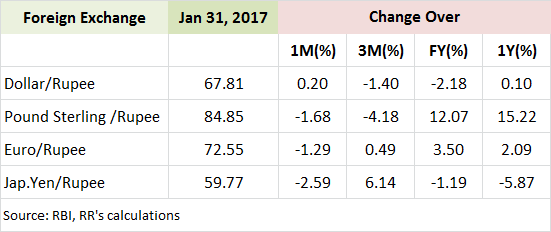
Some points to note:
Most of the rupee's fall against the dollar has come after demonetisation.
Bonds are the best performing asset after demonetisation, and this financial year.
Gold has been weak after demonetisation.
The government bond yield curve has steepened this FY 16-17 and after demonetisation.
Data up to September quarter of 2016 shows that the Chennai and Bengaluru continue to be positive, but at the national level there is no upward momentum.
Foreign Exchange
Stock Market

Government Bond Market


Gold

Money Market

Policy Rates

Bank Deposit Rates


Public
Provident Fund

Post Office Deposits


Lending Rate


Please aslo see last month's map
Friday, 3 February 2017
Monitoring the Bull Market in Indian Stocks: Update as of January 2017
Indian Stock Market Watch


Please see my blog of July 9, 2014 for the original note on using TMV/GNP ratio to gauge whether the market is cheap or expensive.
Subscribe to:
Posts (Atom)