Friday, 20 January 2017

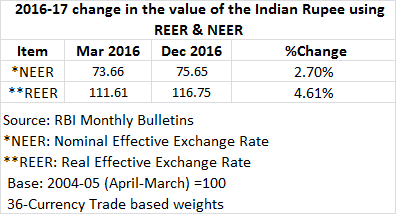
The value of the Rupee: update as of December 2016

Rupee at its highest level since April 2004 on a real exchange rate baisis


Please also read my April 25, 2014 blog titled "Is the Rupee fairly valued?" and my monthly blogs.


Wednesday, 18 January 2017

The flow of money up to Q3 2016-17: what do the numbers tell us?

Credit growth exceptionally weak - post-demonetisation credit growth has been nil

Deposit and credit growth

Credit growth just 1.4%  even though three quarters of the financial year is over (RBI's last reporting date for Q3 was December 23, 2016).


On a year-on-year basis, the number is half that of the previuos year.


Post -demonetisation, credit growth has been nil!

On December 23, 2016, outstanding credit was Rs. 73,480 bill, marginally lower than the amount outstanding on November 11, 2016 (the first reporting period after demonetisation) of Rs. 73,532 bill.

Money Supply


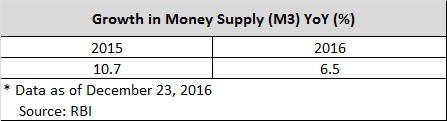
The sharp deceleration in money supply growth as measured by M3 - the sum of currency in circulation, demand and time deposits-  is explained by the fall in absolute level of money supply post-demonetisation: since the first reporting period of November 11, money supply has fallen from Rs. 123,767 bill. to Rs. 120, 449 bill.

In an ideal world this should not happen : demonetised notes get  surrendered to the bank and then they become deposits; so as one component of money supply falls, the other rises. In India's case currency in circulation has fallen, but demand and time deposits have not risen by the same amount, leading to a net fall in money supply by Rs. 3,300 bill. Why?

This could be a technicality, in my view, because when one looks at the sources of money supply growth (the equal flip side of the components of money supply), there is a Rs. 3800 bill. rise in banking sector's non-monetary liabilities, which perhaps are deposits  but which have temporarily not been reported as such by banks for some reason. 

Reserve Money

Reserve Money - also known as high-powered money because changes in this could have multiplier effects on money supply - has collapsed  post-demonetisation: from Rs. 22,490 on November 11 to Rs. 14, 355 bill. on December 30 (RBI's last reporting date for Q3). This accounts for the sharp fall in reserve money growth in the current financial year. The components of reserve money are currency in circulation, bankers' deposits with RBI, and other deposits with RBI.


This is what seems to have happened: to mop up the surge in liquidity in banks, the RBI sold government securities; this led in turn to a sharp fall in net RBI credit to government by Rs. 5900 bill. - one of the sources of variation in reserve month growth (the flip side of the components of reserve money) ; liquidity was also absorbed by RBI by a sizable fall in its net credit to banks and the commercial sector by Rs. 1800 bill. - another source of variation in reserve money growth. 

So, here again, it appears the overall collapse in reserve money growth may be a technicality - it being reflected as a reduction in assets rather than as a rise in liability of the RBI in the form of deposits by banks with the RBI, which is a component of reserve money.


Tuesday, 3 January 2017

India Market Map: December 2016

A bird’s eye view of the performance of India’s financial markets.


Foreign Exchange


Stock Market


 Government Bond Market


Gold Price 


  Money Market


Policy Rates


 Bank Deposit Rates


Public Provident Fund Rate


 Post Office Deposit Rates


Lending Rates


 Real Estate Market


Monitoring the Bull Market in Indian Stocks: Update as of December 2016

Indian Stock Market Watch


Please see my blog of July 9, 2014 for the original note on using TMV/GNP ratio to gauge whether the market is cheap or expensive.

Thursday, 15 December 2016

RBI sees demonetisation as a non-event: Prescience or helplessness?

Fifth Bi-Monthly Monetary Policy Statement, December 7, 2016

Monetary Policy                                                                                                     2016-17

Not altogether a surprise that the Monetary Policy Committee chose to keep the repo rate unchanged at 6.25%.

In my blog of November 25, 2016 on the November 8 demonetisation of Rs. 500 and Rs. 1000 notes and the uncertainty it had created for the growth of the economy in FY 2016-17, I had expressed the view that a reduction in the repo rate was likely, unless the rupee comes under significant pressure. The rupee did come under significant pressure, falling at one point by over 3% against the U.S. dollar since the last policy announcement on October 4. In its outlook, the MPC noted that ‘U.S. monetary and fiscal policy could impact volatility to the exchange rate thereby feeding into inflation’ – the term ‘volatility’ being the RBI’s euphemism for weakness, in my view.

Significantly, the RBI sees the effects of demonetisation on the growth of the economy as purely ‘transient’. In theory this is true as demonetisation is simply the substitution of one set of notes by another happening without lag and friction.

Although, the RBI has reduced its growth target for the year from 7.6% to 7.1%, in the words of the Executive Director in the conference call with media, only 0.15% of the reduction is due to demonetisation. The remaining 0.35% is due to the lower than expected number of 7.1% for growth in Q2 FY 2016-17. Perhaps the RBI feels that it has no hard data points as yet on the effects of demonetisation on growth, despite the widespread media reports about the difficulties faced by most sectors and people in accessing cash, and the consequent slowdown in spending.

On the inflation front, there is no change in RBI’s projected inflation path – 5% by March 2017, with risks to the upside, although lower than the October policy review.
If this is the picture that the RBI has of the economy for the rest of FY16-17, then its decision to make no change in the repo rate is warranted. But is this picture correct? It is hard to believe, at least based on media reports, that this is the case so far as the growth of the economy is concerned. What about hard data points?

On December 9, the RBI released fortnightly data on credit and deposits in the banking sector. In FY 2016-17 up to November 25, credit grew by just 0.6%! At the end of two quarters, i.e. up to September 30, 2016, credit grew by 3.7%, less than the 4.2% seen in the same period during the previous year.

So from September 30 to November 25, bank credit actually fell - by Rs. 2,282 billion.  Significantly most of that fall - Rs. 1672 billion - it appears happened even before the demonetisation on November 8!


On the inflation front, where RBI did not have the benefit of hindsight, data was released just two days ago which showed that consumer price inflation for November came in at 3.63%, well below expectations. Does this suggest a softer inflation path than RBI’s current one going into March 2017? Clearly one data point is not sufficient. The RBI is in a wait and watch mode.

It is quite a surprise that at the MPC meeting all members unanimously agreed that no change in the repo rate is warranted.

Meanwhile, some banks have cut their deposit rates and a few their lending rates.


One weakness with the MPC’s assessment and past statements is that it does not show trends in bank credit and deposits, money supply and reserve money on a regular basis - even though the RBI is directly attempting to influence both the price and flow of money in the economy through its monetary policy actions. This is necessary.