Thursday, 18 February 2016

Sixth Bi-Monthly Monetary Policy Statement on February 2, 2016 by Governor Rajan: No surprises

But will the current stance of monetary accommodation be able to withstand a China shock?
 Monetary Policy                                                                                                     2015-16
Please read my blog of December 11, 2015.
The last monetary policy statement for 2015-16 contained no surprises: all key rates are on hold.
As I had indicated in my December blog a further easing in the repo rate could be expected only next financial year, if inflation follows the projected trajectory of the RBI – 5% by March 2017.
Loans based on the marginal cost of bank funds will come into effect from April 1, 2016.It will be interesting to see whether this induces banks to pass on more of the 1.25% reduction in the repo rate by the RBI.
Last month saw fresh turbulence in the financial markets, with China at the epicentre of it as its stock markets declined sharply, its currency depreciated, fx reserves fell by more than $ 100 billion, and importantly its regulators lost some credibility in managing markets. India’s economy withstood the turbulence fairly solidly. The SENSEX fell, the rupee weakened against the U.S. dollar but was stable against a basket of currencies, fx reserves fell marginally in January and have since risen, and some money market and bond market rates saw an upward tendency.
India’s superior performance relative to most other emerging markets over the last one year rests on both the government and the RBI taking positive policy and administrative measures. It will be interesting to see what positive surprises government unveils in its next budget due in less than two weeks.
The government is committed to fiscal consolidation, i.e. keeping government spending under control. There have been suggestions in some quarters that government perhaps should go a little easy on fiscal consolidation, and thereby give a boost to the economy to counterbalance the still weak private sector investment. The RBI’s desire as articulated in the monetary policy statement is clear: it prefers the government to undertake structural reforms rather than increase government spending that pushes back the country’s fiscal consolidation target.
China is a source of turbulence in the global economy. The economy has seen a hard landing - how else can one characterise an economy whose growth has halved from heady levels well in excess of 10%?   But a shock would be another matter.

A China shock could come from various sources: excessive debt, troubled banks, a sharp devaluation of the yuan.  This would be a stern test for the RBI’s current course of monetary easing as contagion takes effect. The RBI may then be forced to abandon its current monetary policy stance as it fights stress in multiple markets such as fx and money.

Wednesday, 17 February 2016

The value of the Rupee: update as of January 2016

Rupee remains relatively stable against a basket of currencies amidst global turbulence in January

RBI Watch                                                                                                 Indian Rupee


Please also read my blog of December 18, 2015.


Tuesday, 16 February 2016

The flow of money does not suggest that India’s economy will move to a significantly higher growth path soon


Money is a fuel that economic agents use to produce and deliver goods and services. So let’s look at the numbers to get a sense of the prospects of India’s growth in 2015-16 and the next year.

The tables below give the numbers for deposit mobilisation and credit disbursed by banks in the current financial year up to January 22, 2016. Both this financial year and over the last twelve months ending January 2016 there has been an increase in credit growth by 1 to 2%. Deposit growth has seen no change. 


A lag between credit creation and economic growth is to be expected as economic agents first build factories, make purchases of raw materials and then run the factories and deliver goods to consumers. This suggests there is likely to be a pick-up in India’s economy in 2016-17. But the pick-up is likely to be slow. During the years from 2004 to 2008 when the economy was growing in the 8-10% area, credit grew well in excess of 20% per year. Deposits during the same period grew close to 20%.

Let’s also look at two other foundations of money in the economy -money supply and reserve money? Reserve money consists of currency in circulation and the deposits of banks with the RBI. It is reserve money that the RBI can use to influence the growth of money supply. Money supply consists of currency in circulation, demand deposits (money in savings bank and current accounts) and time deposits (fixed deposits).

The tables below give the numbers.


The trend in the current financial year suggests barely any change in the growth of money supply –about 11%, roughly the same as last year. During India’s high growth years from 2004 to 2008 money supply grew by close to 20% per year.


The picture on reserve money is different – there has been a jump in growth: 12% over the last one year compared to 10% in the previous year. Does this suggest acceleration in money supply and credit in 2016-17? The potential is there but it is still early days to make a confident call.


In conclusion, the money flows during the current financial year upto January 22, 2016 does not suggest a sharp buoyancy in the economy. There is some pick up in credit, which could lead to slightly higher growth next year – we are, however, still far away from the boom years of 2004 to 2008.


Monday, 1 February 2016

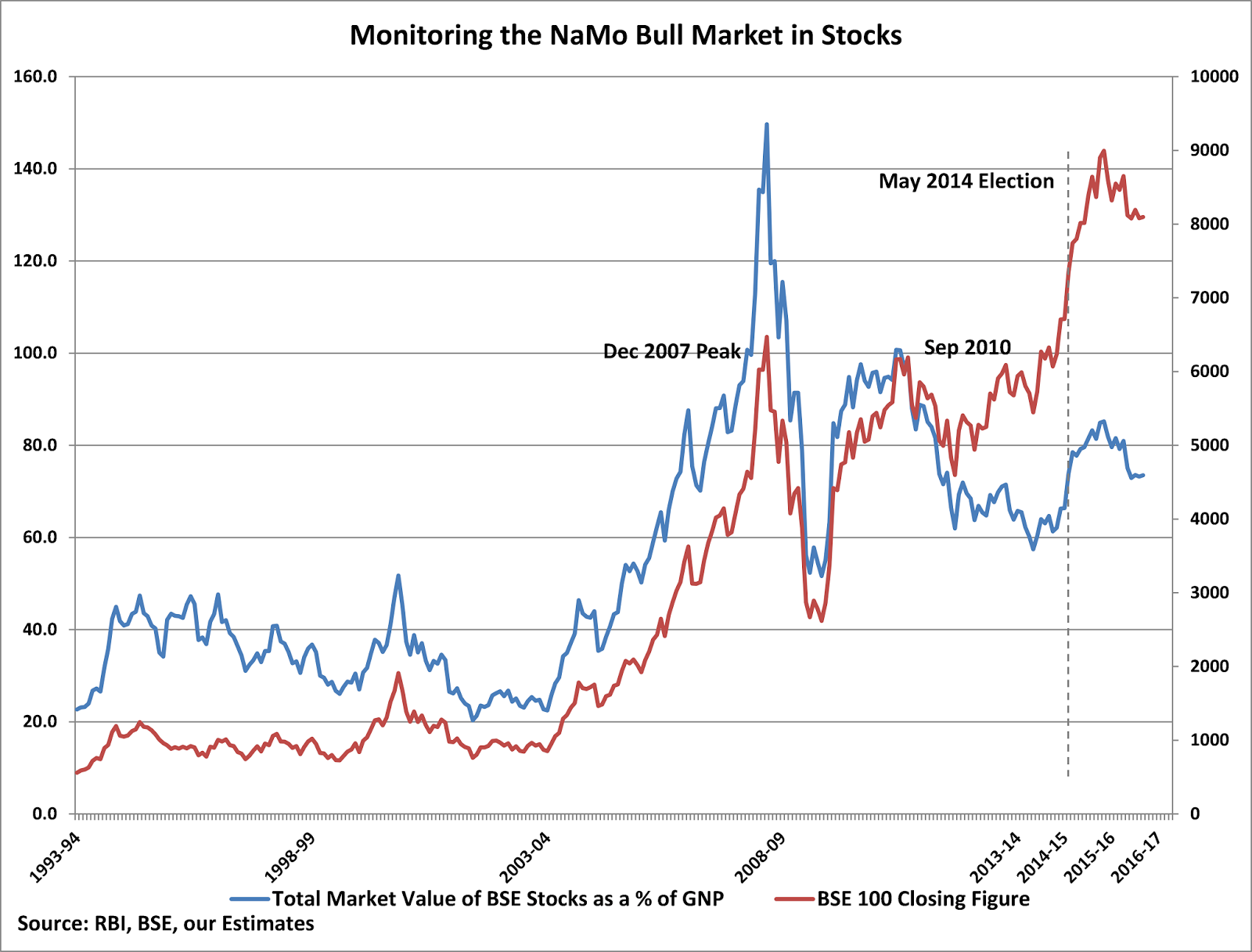
Monitoring the Bull Market in Indian Stocks: Update as of January 2016

The NaMo bull market in stocks is at a critical point

Indian Stock Market Watch

As of end January, 2016, TMV/GNP is estimated  at 68%. The last time market capitalisation of BSE as % of GNP fell below 70% was in April 2014, the month before Narendra Modi came to power. 

Since the end of the global financial crisis TMV/GNP ratio fell for about two years - from  September 2010 to August 2012. During this phase, the low for the ratio was 57.5%.


Please refer to my blog of July 9, 2014 for the original note on using TMV/GNP ratio to gauge whether the market is cheap or expensive. 


Wednesday, 13 January 2016

The value of the Rupee: update as of December 2015

RBI Watch                                                                                                 Indian Rupee


Please also read my blog of December 18, 2015.


Monday, 4 January 2016

Monitoring the Bull Market in Indian Stocks: Update as of December 2015

Indian Stock Market Watch


Please refer to my blog of July 9, 2014 for the original note on using TMV/GNP ratio to gauge whether the market  is cheap or expensive. 


Friday, 18 December 2015

Rupee update as of November 2015: Despite the recent fall of the rupee against the US Dollar, India’s currency has performed well and is overvalued


Using the foreign exchange reserves to defend the rupee on a sustained basis should be avoided

RBI Watch                                                                                              Indian Rupee

Below are the usual two tables I produce each month - the idea being to see how the rupee has performed not just against the US Dollar, which can be misleading, but against a basket of currencies.  Why? When we look at inflation in India, do we measure it by just what has happened in the price of a mobile phone? No, to get the correct picture we measure inflation against a basket of goods typically consumed by a household in India.


I emphasize this because a few days ago the rupee fell against the US dollar to 67 rupees, a level last seen in August 2013, when worries about India's burgeoning current account deficit pushed the rupee to a historic low of 68.4. The rupee has fallen by over 7% against the US dollar in the last year. Most of this fall has occurred this financial year – a fall of 6%.


But let's see how the rupee has performed against a basket of currencies, representative of the countries India trades with actively. 

The Reserve Bank of India publishes this data every month.  I use that data for creating my monthly tables. 

Against a basket of currencies (Net Effective Exchange Rate), the rupee has actually strengthened by about 1% over the last one year. However, during the current financial year - in India we start this on April 1 - the rupee has fallen by about 3%. This is a remarkable performance considering that over the last one year most emerging market currencies have fallen sharply - many to record lows.

To get the full picture lets also look at the rupee in real terms (Real Effective Exchange Rate), after adjusting for inflation with India's principal trading partners. By this measure, over the last one year the rupee strengthened by 3%. During the current financial year, the rupee in real terms has fallen, but by a negligible 0.2%. The bottom line is that in real terms the rupee continues to be overvalued - an index level of 100 suggests that the rupee is somewhat fairly valued, and many consider an index level above 110, a 10% overvaluation, a case of significant overvaluation.

Overvaluation can persist for long periods of time. I would be really concerned if the index, REER, was in the 120 range.

The picture of the rupee suggests that, on balance, economic agents – domestic and foreign – have confidence in the currency. India has seen foreigners invest more in India – both in setting up factories and services as well as investing in India’s financial markets, such as bonds and equities. From a trade perspective, the picture has not been rosy. Weak world growth and a slowing economy at home have seen significant declines in exports and imports. India’s current account deficit is low and manageable, but one that comes from falling exports and imports is less positive than a higher current account deficit, which results from a rise in exports and imports, in my view

A more competitive rupee would be a bonus for the country.

The Federal Reserve has announced two days ago a rise in the target federal funds rate. Interest rates are expected to rise in the USA in 2016. There could be some unexpected twists in the world’s financial markets and economy next year.

The RBI could be well served to avoid the temptation to use India’s foreign exchange reserves to defend the rupee on a sustained basis. Although India’s reserves have increased, the truth is that any amount of reserves in not enough. Look at China sitting on 3.4 trillion dollars of reserves. In two months in the recent past, reserves fell by more than a whopping 80 billion dollars – last month the fall was $87 billion, and in August it was $ 94 billion!