Tuesday, 14 April 2015

The value of the rupee: A look at the numbers for the year 2014 - 15

RBI Watch                                                                                               Indian Rupee

Over the last one year, the rupee appreciation against a representative basket of currencies appears significant in real terms  - about 9% measured by the Real Effective Exchange Rate (REER). The rupee was close to fair value - at the start of the financial year, but with REER rising to 113.23 it appears significantly overvalued. REER  is the value of the rupee versus a basket of currencies adjusted for inflation between India and the countries in the basket.

In nominal terms, the rupee has also appreciated against a basket of 36 currencies by about 7% as measured by the Net Effective Exchange rate. To give readers a flavour of how this could have happened, the second table shows the rupee movement against some of the world's major currencies. While the rupee fell by 4% against the US dollar, it rose, for example, against the pound by 8%, and 22% against the euro.


The difference between the gain in the rupee  in real and nominal terms is explained by the higher inflation at home compared to the inflation abroad (the 36 countries in the basket used for comparison purposes by the RBI).


The rupee has lost some competitiveness in the last one year from a trade perspective. On the other hand, rupee assets - such as stocks and bonds - for investors from countries such as the Euro area, the UK and Japan have turned out to be attractive given the strengthening rupee. Even against the dollar, the rupee's depreciation has been mild, keeping rupee assets attractive.

The RBI does not target a nominal rate for the rupee. Its intervention in the foreign exchange markets is generally to prevent excessive volatility in the rupee.  


First , April 7 , 2015, Bi-Monthly Monetary Policy Statement by Governor Rajan: Is RBI moving towards micromanaging the pricing of loans and deposits?

RBI Watch                                                                                    Monetary Policy 2015-16

The monetary policy cycle for the new financial year , 2015-16, has started with no change in the monetary policy stance of the RBI. 

A quick recap on monetary policy in the last financial year, 2014-15: RBI started the year with the policy repo rate at 8%, then moved it lower in two steps ( between scheduled bi-monthly statements) to 7.5% in January and March; RBI reduced the SLR in small steps (0.5% each time) in June, August and December to 21.5%.

The real story of this start to the year is the extreme unhappiness of the RBI at the unwillingness of banks to reduce their lending rates despite the reduction in the repo rate by the RBI - an accommodating move that arguably started even earlier with the reduction in the statutory liquidity ratio (SLR) of banks. So much so that Rajan has stated that a key factor in the next interest rate move (presumably downwards) will be the extent of the follow through by banks to reduce their lending rates.

I had in my first blog on monetary policy on April 16 last year devoted a section to this issue titled "Transmission of Monetary Policy to lending rates is a problem" . Later in my blog of December 31 last year, I concluded that given the liquidity position of banks then, they could reduce lending rates without waiting for the RBI to reduce the policy rate. I suggest a reading of both these blogs.

Now things have really come to a head between the RBI and the banks. Rajan has announced that banks will soon need to move to a marginal-cost-of-funds- based determination of the base rate, the benchmark minimum lending rate of banks. 

I believe this is the wrong move. RBI should not end up unwittingly micromanaging the pricing of loans and deposits. India's banks are by and large well run, and some of them are world class. Base rates based on the average cost of funds make as much sense as their determination by the marginal cost of funds. Banks as commercial enterprises should be free to determine their approach to pricing loans and deposits. The important point should be that pricing must be consistent, transparent, and fair. Consistency, and transparency would enable customers to make the best decisions in their interest, and fairness would make it equitable, both in terms of large and small customers and new and old customers of the banks.

Instead, RBI needs to hasten the pace of development of deeper money and bond markets. This will make accessing bank loans and the markets equally attractive for customers, and force banks to be more responsive. Also, RBI needs to continue to reduce the mandatory investment in government securities by banks by reducing the SLR still further and in bigger steps.

Note, in another move that was initiated last year by the RBI, Financial Benchmarks India Private Ltd, has been set up, and will become operational soon. The idea is that this enterprise will develop independent benchmarks to facilitate the pricing of deposits and loans, and RBI will encourage banks to use these benchmarks.

Finally, a word on the path of inflation this year. From RBI's point of view, inflation will further fall to as low as 4% by August, but then rise to close to 6% by end of the year. RBI's message is clear to my mind: transitory falls in inflation will not warrant a further reduction in the policy repo rate. So expect a cut in the repo rate only if inflation falls unexpectedly and on a sustained basis below 4% after August. 


Saturday, 4 April 2015

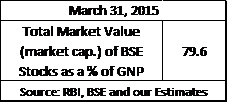
Monitoring the Bull Market in Indian Stocks: Update as of March 2015

Indian Stock Market Watch


Please refer to my blog of July 9, 2014 for the original note on using TMV/GNP ratio to gauge whether market is cheap or expensive. 

Saturday, 14 March 2015

The value of the Rupee: appreciation in real terms now exceeds 10% over the last one year


RBI Watch                                                                                               Indian Rupee


The tables below gives the picture in real and nominal terms against a basket of currencies. Please read my blog of April 25, 2014.

Just to get a sense of where these numbers are coming from in nominal terms - the way we all understand it when we go to a counter to exchange rupees to dollars or conversely, the rupee over the last year has appreciated by 19% against the euro, 5% against the pound, 13% against the yen, but has fallen a small 3% against the US dollar.


Wednesday, 11 March 2015

Agreement on Monetary Policy Framework: Central banking goes modern in India

RBI Watch                                                                                    Monetary Policy 2014-15

Yesterday’s blog referred to the February 20 agreement between the government and Reserve Bank of India, where RBI has a target to keep inflation at the 4% level with a band of +/- 2%. The  two page Agreement on Monetary PolicyFramework between the government and RBI is compulsory reading – for students of economics, voting citizens of India, foreign investors and firms. 

As with any agreement, what is perhaps just as important is what it does not say. I leave it the readers to make their own judgement and interpretations. From my side, I would have liked to have a sentence which stated that “the government on its part will take necessary measures to support RBI’s inflation target”. Please read my blog of October 22, 2014 to put this in context.

A noteworthy feature of the MPF is how much time the RBI gets before the government and the public can say that RBI has failed in achieving its target: a level of inflation outside the 6% to 2% range for three consecutive quarters (I am presuming the condition is not three consecutive quarters in a financial year, although one could interpret the agreement to mean just that). This gives considerable latitude to the RBI. I would have preferred a shorter time frame of two consecutive quarters.

The MPF will see changes. The government and RBI have yet to decide on the powers and composition of a Monetary Policy Committee led decision making of the policy rate and other measures that are taken to achieve the target.  Please read my blog of October 22, 2014 on this subject.


As per the agreement, the Governor is responsible in setting the policy interest rate and other measures to achieve the target, but if he or she fails then it is the RBI that must come up with an explanation and remedial measures! Even before the introduction of the MPC, the present system needs to change – in both cases it should be the RBI. 

Tuesday, 10 March 2015

The future path of RBI’s policy rate: What does it mean for borrowers, depositors and investors?

Scenario Analysis if RBI achieves its mandated central target

RBI Watch                                                                                    Monetary Policy 2014-15

The Monetary Policy Framework of February 20 this year between the government and RBI lays out in explicit terms RBI’s mandate: CPI by January 2016 should be 6%, and from then on in subsequent financial years 4% plus or minus 2%.

Last week, in an inter-meeting move, the RBI reduced the repo rate by 25 basis points to 7.5%. Given RBI’s determination to keep the real rate 1.5 to 2% above the policy rate and assuming inflation does reach close to 6%, the repo rate should be still at 7.5% in March 2016.

Today inflation is about 5%. In fact, inflation has fallen at a much faster pace than projected by the RBI. So, should this not push the RBI to lower the repo rate to about 6.5%? If inflation is sustained at this level or falls further, then RBI will be under pressure to lower the repo rate. But it would not want to be caught in a situation where it lowers the rate, but is then forced to raise it again if inflation rises as the January 2016 target date is reached. Hence, my sense is that RBI as far of possible will keep the repo rate at the current level of 7.5%.

Note also the US Fed is expected to raise the federal funds rate later this year, as early as June. RBI would like to manage successfully possible capital outflows and rupee volatility around this event. Hence it makes sense to make no further reductions in the repo rate for now.

Moving to the next target, if inflation trends lower to the central target of 4% by March 2017, the repo rate should be about 5.5%. So, we are talking about a 2% fall in the repo rate by March 2017.
What does this mean for borrowers? Today, the base rate – the minimum lending rate, ostensibly for the best customers - charged by banks is in the region of 10%: SBI, the largest bank has it at 9.8%, and ICICI bank, the largest private sector bank, has set it at 10%. This means that bank base rates could come down to about 8% by March 2017. Deposit rates will also fall – one year deposit rate could fall from the current 8.75% or so to 6.75%.

Surely, this will be huge positive for India’s bond and equity markets. Prices of bonds vary inversely with interest rates, and lower borrowing rates should increase corporate profits. A thirty percent increase in the SENSEX is a distinct possibility.

Will this scenario pan out?

Inflation has fallen steeply and far beyond the RBI’s expectations because demand has been very weak in India, and the global environment has been exceptional – the developed world is beset by the spectre of deflation. Tight monetary policy by the RBI till recently has played some part.
India wants more growth not less. There are signs that the economy is picking up again, and growth is expected to be about 8% in 2015-16. In the longer run, the government wants a growth rate in the region of 10%.

So, how does the economy grow significantly faster, and yet have significantly less inflation. One step is government putting its finances in order - fiscal consolidation. This means more investment spending as compared to consumption expenditure, and much less leakages in consumption spending. This budget proposes to address both these issues. But we need much more: better governance and more efficiency in government. And we need more reforms in the economy – on this front the government is moving ahead at a steady pace.

On the private sector front, we need more investment. But in many sectors, the private sector is sitting on excess capacity and is overburdened by debt. So it does seem unlikely that there will be a major expansion in private sector investments.

The scale of the change required in two years - by financial year 2016-17 - to increase the productive capacity of the economy appears formidable.

To my mind, a key factor in RBI attaining its target of 4% inflation by March 2017 will be the continuation of the truly exceptional global disflation/deflationary environment we are in today.  Please see my earlier bogs on this subject.

Note: if inflation rises from the current level to 6% by March 2017, RBI would have achieved its target:  4% with a band of +2%.  It will be interesting to see the evolution of monetary policy over the next two years under the Monetary Policy Framework.  What will be RBI’s tolerance for inflation above the central target but within the 2% excess band? Let’s wait and watch.

Monday, 2 March 2015

Monitoring the Bull Market in Indian Stocks: Update as of February 2015

Indian Stock Market Watch


Please refer to my blog of July 9, 2014 for the original note on using TMV/GNP ratio to gauge whether market is cheap or expensive.